Menu
- Circuit Breakers
- Previous Generation Circuit Breakers
- Insulated Case Circuit Breakers
- Enclosed Circuit Breakers
- Residential Circuit Breakers
- Remote Racking Devices
- Miniature Circuit Breakers & Supplementary Protectors
- Miniature Circuit Breakers (MCB)
- Medium Voltage Circuit Breakers
- Medium Voltage Outdoor Dead Tank Breakers
- Low Voltage Power Circuit Breakers
- Molded Case Circuit Breakers (MCCB)
- Arc Flash Protection Systems
- Load Break Switches
- DC High Speed Circuit Breakers
- Contactors and Relays
- Cabinet Climate Control
- Automation and Industrial Electronics
- Energy and Power Supply
- Oil and Gas Industry
- Industrial Communication and Networks
- Drive Technology, Motors and Gearboxes
- Components for Electrical Cabinets and Distribution Systems
- Valves, Pipeline Fittings and Hydraulics
- Software for Automation and Dispatching
- Lighting Equipment and Electrical Products
- Cable Products and Electrical Connections
- Building Security and Automation Systems
- Pump Equipment and Liquid Supply Systems
- Industrial Filtration and Purification Systems
- Explosion-Proof Equipment (Ex-Certification)
- Instrumentation and Measurement Devices (I&C)
- Bearings, Linear Motion and Power Transmission
- Hand and Power Tools
- Fasteners and Fixing Technology
- Welding Equipment and Consumables
- Industrial Lubricants, Oils and Coolants
- Adhesives, Sealants and Industrial Chemicals
- Personal Protective Equipment and Workplace Safety
Sign in
How to Correctly Select a Frequency Converter for a Motor
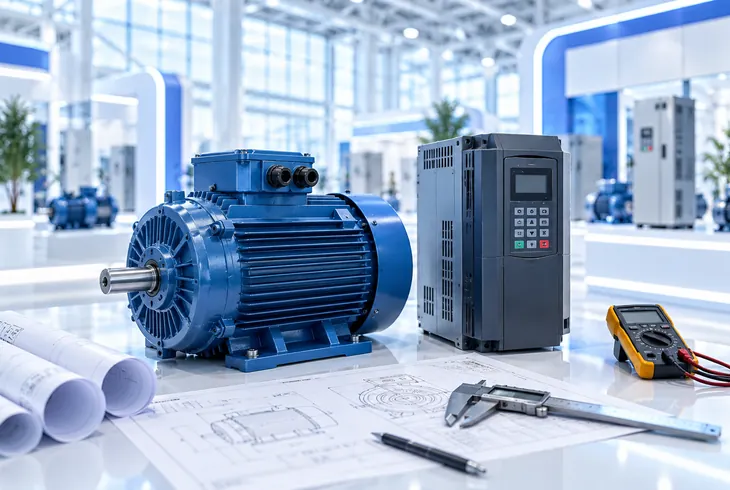
A frequency converter (FC) is the "brain" of an electric motor. For it to run efficiently and reliably, it's important to size it correctly for the load.
- Determine the motor's power rating. Check the table on the nameplate (kW or HP). If the motor operates under variable load, take the rated power and add a 10–15% margin.
- Account for the rated current. The FC must be able to handle the motor's rated current at full load. If the current is close to the FC's maximum limit, choose a higher-class model.
- Margin for starting loads. Heavy machinery (crushers, presses, compressors) requires an FC with a 20–30% power margin.
- Supply voltage. 220 V — low-power motors (up to 3 kW); 380 V — industrial equipment (3 kW and above).
- Operating conditions. Dust, humidity, high temperature — requires an FC with an IP54 or higher protection rating; IP20 is sufficient for clean rooms.
Tip: don't skimp on the power margin — overload is the main enemy of a frequency converter. Dynamics Engineering specialists will select the optimal FC based on your site's parameters and help with commissioning, technical documentation, and integration with the process control system (APCS).